-
houses: the 12 divisions of the chart or the “heavens”, each one with rulership over specific areas of life.
-
luminaries: the Sun and the Moon
-
natal chart: horoscope drawn for a person’s birth, also known as birth chart.
-
cusp: the beginning of a house in the chart, the degree when one sign ends and the other begins
-
glyph: the symbols used for the signs, planets, aspects etc.
-
electional astrology: a branch of astrology in which favorable times (e.g. best time for a couple to be wed, or for a business to launch) are elected or chosen in advance
-
synastry: the art of relationship astrology
-
dirunal/nocturnal chart: a type of natal chart interpretation that adds a layer of meaning to the overall chart and how a person feel’s its planets influences
-
angles: the four angular points of the circle chart
-
quadrants: there are 4 “quadrants” in a chart, and each starts at the cusp of the first, fourth, seventh, and tenth houses. (read about hemisphere emphasis).
-
decans: each sign is divided into three distinct segments of 10 degrees each. The first, second and third decan respectively.
-
aspects: the various angular relationships the planets have to one another as they move in orbit. These are expressed in degrees, typically in multiples of 45 (45°, 90°) or 30 (30°, 60°, 90°, 120° and so on.) When two planets form an aspect with one another, their energies and natures will work in either harmony or discord. The five major aspects are:
- conjunction (0 degrees)
- sextile (60 degrees)
- square (90 degrees)
- trine (120 degrees)
- opposition (180 degrees)
-
orb: when determining whether one planet forms an aspect to another, astrologers allow an “orb” of influence, which is a specific number of degrees. When an aspect is exact, it has its greatest impact. But the effect of most aspects can be felt for some time before and after the moment when it is exact. The range within which an aspect is in operation is called its ‘orb of influence’, or simply its orb. An orb of one or two degrees of arc on either side of the exact aspect is considered a close or tight orb, while an orb of 10 degrees is loose.
-
emphatic aspects: the specific aspects that emphasize or align two planetary energies with one another. Specifically conjunction (0 degrees) and opposition (180 degrees).
-
hard aspects: the specific aspects that signify discord, challenge and blockages.
- opposition (180 degrees)
- square (90 degrees)
- semi-square (45 degrees)
- sesquiduadrate (135 degrees)
-
soft aspects: the specific aspects that signify ease, flow, clarity and vision. Too few soft aspects can represent lostness or confusion about one’s life, while too many soft aspects make for a life that is overly mental and lacking in substance.
- conjunction (0 degrees)
- semi-sextile (30 degrees)
- sextile (60 degrees)
- trine (120 degrees)
-
grand trine: an aspect pattern where three or more points form mutual trines to each other, forming a triangle on the natal chart.
-
critical degrees: sensitive, emphasized and often strengthening points of a sign
-
elements: the four characteristics a sign may have, based on the four classical elements
-
modalities: the three different ways a sign may express action and energy
-
polarities: the two different energetic characteristics a sign may have
- nocturnal, feminine, yin, or recessive/receptive (Taurus, Cancer, Virgo, Scorpio, Capricorn)
- diurnal, masculine, yang, or dominant/active (Aries, Gemini, Leo, Libra, Sagittarius, Aquarius, Pisces)
-
part of fortune: wherever the part of fortune is found in the natal chart is the place where a person is thought to possess natural talent.
-
personal planets: the inner planets and luminaries, until Mars
- The Sun
- The Moon
- Mercury
- Venus
- Mars
-
big three: a colloquial term for the combination of Sun sign, Moon sign, and Rising sign placements of an individual.
-
planetary rulers: the planet that “rules” each sign, and has a unique relationship to it as well as overlapping traits and areas of concern.
- In the classical ruler assignments, Uranus, Neptune and Pluto are not considered rulers. Hence, Mercury, Venus, Mars, Jupiter and Saturn rule over two signs each.
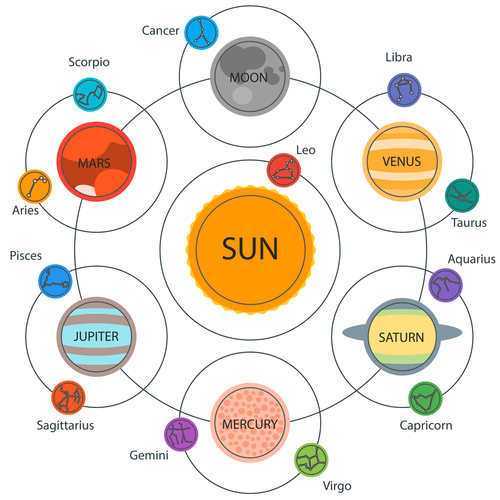
- In modern ruler assignments, Uranus, Neptune and Pluto take over rulership of Aquarius, Pisces and Scorpio respectively. Mercury and Venus still rule over two signs each.
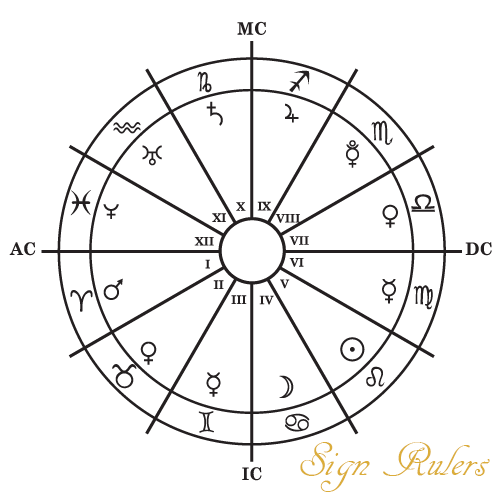
- In the classical ruler assignments, Uranus, Neptune and Pluto are not considered rulers. Hence, Mercury, Venus, Mars, Jupiter and Saturn rule over two signs each.
-
benefic: Some planets are more “helpful” than others, specifically Venus (the lesser benefic) and Jupiter (the greater benefic).
-
malefic: The opposite of benefic. Some planets are more challenging than others, specifically Mars (the lesser malefic) and Saturn (the greater malefic).
-
essential dignity: the relative strengths and weaknesses of a planet relative to the sign it’s currently in. The four essential dignities are:
- domicile: the sign that the planet rules, and where it feels “at home”
- detriment: the sign that is opposite a planet’s domicile, where it is least effective
- exaltation: the sign where a planet is refined and recognized
- fall: the sign opposite a planet’s exaltation, where it feels less recognized and is disadvantaged
-
retrograde: a planet is considered “retrograde” when it appears to be moving backwards. both “retrograde” and “direct” are terms used in astrology to describe the direction of planetary movement with relation to the Earth. note that the planets do not actually move backwards. However, they appear (from our perspective on Earth) to back up for periods of time. the Sun and the Moon never retrograde
-
void-of-course: a planet that does not apply to a major aspect until it changes sign, usually referring to the Moon. a void-of-course Moon time period is often considered to be a less than favorable time to start a new project. instead, this period is best used to reflect, review, and re-organize.
To add:
- ingress
- house systems
- lunar nodes
- lunation
- retrograde shadow (pre and post)
- returns
- sect
- stellium
- transit