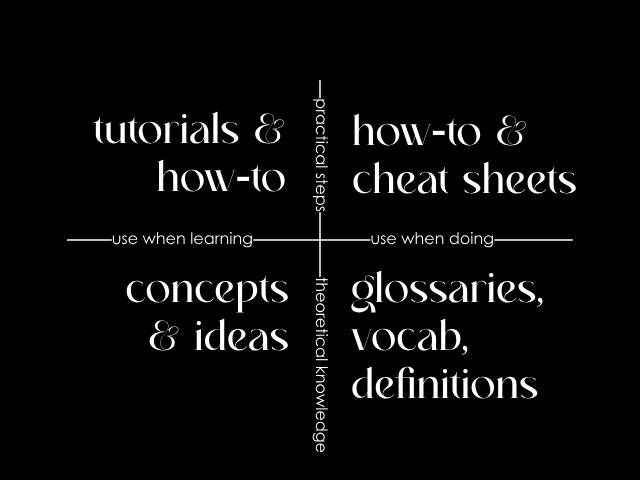
Diataxis organizes documentation onto two axes: “practical steps” versus “theoretical knowledge”, and “serving our study” versus “serving our work.”
- Tutorials are written in practical steps to support studying; they can be considered “learning-oriented.”
- How-to Guides are written in practical steps and support work; they can be considered “doing-oriented” or “problem-solving-oriented.”
- Explanations are written as theoretical knowledge to support studying; they can be called “understanding-oriented.”
- Reference are written as theoretical knowledge to support work; they can be called “information-oriented.”
The framework’s purpose is to define types of documentation in order to address various needs, learning styles, and work support. This is typically applied to technical documentation and doesn’t typically work for other types of file organization.
-
How might we expand this to non-documentation storage types?
- The axes could remain largely the same, except I think “how-to guides” are any practical step-by-step guide (whether i)
- Perhaps there should be an additional aspect which is internally and internally created, sort of applying Bloom’s taxonomy. Or for a stage of development, related to the gardening analogy.
-
Tutorials are written in practical steps for use when learning or developing skills.
-
How-to Guides are written in practical steps and support work; they can be considered “doing-oriented” or “problem-solving-oriented.”
-
Explanations are written as theoretical knowledge to support studying; they can be called “understanding-oriented.”
-
Reference are written as theoretical knowledge to support work; they can be called “information-oriented.”