
Definition
Zettelkasten is a German word which translates to "note box."
It’s an index card personal knowledge management system that helps you to retain information that resonates with you, which you then organize, identify, and categorize, to ultimately convert into creative output.
The difference to other systems is that you create a web of thoughts instead of notes of arbitrary size and form, and emphasize connection, not a collection. It’s designed and used to support idea generation, personal knowledge development, and life-long learning.
It’s made up of very few physical components (notes and a note box), nonphysical components (a standard for “processing” notes and linking them) and multiple ideas or principles to keep the framework achieving what it’s intended to.
In short, it’s a framework to help organize your ideas, thoughts, and information. By relating pieces of knowledge and connecting information to each other (by way of hyperlinking), you are replicating a train of thought, helping retain consumed information, and allowing your thinking process to grow organically.
Today’s popular version of the Zettelkasten was developed and made famous by Niklas Luhmann, the father of systems design ^[although the practice of index-card-based knowledge management had an old history going back to commonplace books. Still, I find that even the modern interpretation of commonplace books as picked up by the journaling community remains a spiritual cousin to the zettelkasten practice.]
his note-taking was not leading anywhere. So he turned note-taking on its head. Instead of adding notes to existing categories or the respective texts, he wrote them all on small pieces of paper, put a number in the corner and collected them in one place: the slip-box.
He realised that one idea, one note was only as valuable as its context, which was not necessarily the context it was taken from. So he started to think about how one idea could relate and contribute to different contexts
— How to Take Smart Notes (Sönke Ahrens)
Main ideas
A note is only as valuable as its context, which is not necessarily the context it’s taken from.
atomic notes, or atomicization: Notes should contain one idea, and should be expressed briefly enough to fit on one side of the page. In this way, you’re able to add the same note to different contexts.
“Intuitively, most people do not expect much from simple ideas. They rather assume that impressive results must have equally impressively complicated means.” ((Ahrens, 2017))
slip-box: Keep all notes of similar type (see: Types of notes) in the same place, regardless of topic.
The slip-box provides an external scaffold to think in and helps with those tasks our brains are not very good at, most of all objective storage of information. ((Ahrens, 2017))
- Keeping everything in the same place also eliminates the time and effort spent on deciding where a note should go or what to label it.
rapid capture for externalizing your ideas: Always have a pen in hand to capture notes and ideas as they come.
linking notes and contexts: Following atomic notes, part of the purpose of the zettelkasten is to transition notes and ideas from one context to another, by way of forming tangible and intangible relationships between them, thereby producing new insights and ideas.
- Luhmann did this very intentionally and “wrote his notes with an eye towards already existing notes in the slipbox.” (Ahrens, 2017)
like a translation where you use different words that fit a different context, but strive to keep the original meaning as truthfully as possible. (Ahrens, 2017)
It is not just about collecting thoughts, but about making connections and sparking new ideas. (Ahrens, 2017)
Everything is streamlined towards one thing only: insight that can be published:
- Luhmann “wrote [his notes] with great care, not much different from his style in the final manuscript: in full sentences and with explicit references to the literature.”
- When you get to the development part of the process, part of the work will have already been done because the ideas, the phrasing, the arguments are already there.
bottom-up topics: insight cannot be anticipated or pre-defined, or your notes are your first draft and will tell you what’s important
Transclude of your-notes-are-your-first-draft-and-will-tell-you-what's-important#^bottom-up
index or map of content: A note about a topic can be organically created (bottom-up principle) by sorting and noting the links of related notes
entry points: A note or two that would serve as an entryway into a chain of thoughts/notes or a topic. This can be the index/MOC but doesn’t have to be.
note graveyard, or graveyard for thoughts: Simply amassing notes in one place won’t lead to anything other than a mass of notes. This common error happens from a lack of routine involving the processing and development of notes.
critical mass: If done right (drawing connections between notes to see them in new contexts and spark new insights) the note collection become much more than the sum of its parts.
- The slip-box becomes a “dialogue partner, main idea generator and productivity engine.” Related to this, I love Eleanor Konik’s description of Obsidian as her integrated thinking environment.
- The opposite of “having no idea what to write,” Luhmann constantly generated more ideas than he was able to write down and wrote as if he were trying to fit too many insights into one publication.
Types of notes
Fleeting notes → Inbox
Notes you take of thoughts you get while reading or consuming material.
If not captured immediately, ideas could be lost. At the same time, taking notes shouldn’t distract you from your work.
Fleeting notes are meant to be eventually archived, “a reminder of a thought and are not meant to capture the thought itself” (Ahrens, 2017). These can later be processed or connected to other notes or material, bigger ideas, or converted into new ideas.
Annotations like underlining or marginalia are also just fleeting notes and do nothing to elaborate on a text.
The inbox is the central place to find and later process/organize fleeting notes. If they don’t have a location or a process-later step, they could get lost.
Bibliographical / Reference / Source Notes → Reference or bibliographical system
This is typically the original text that resonated with you, used for citation, reference, quotations, and so on. Tip: Capture the whole paragraph for context but highlight the sentence or expression that resonated with you.
Contains references and brief notes on literature, mostly in response to what was read. Originally the content of the literature on one side of the index card and bibliographical content on the other side.
Use your own words is an important principle of capture — however, bib notes can make up the difference for times direct quotations and citations are needed, especially in academic work.
Literature Notes → Slip-box
These are ideas of the author explained in your own words. These are your learning interpretations of the text you read, revisited in a way that makes it more meaningful to you because you aren’t parroting the original text or taking a separate idea without adding your own.
Lit notes are meant to abstract interesting ideas. Keep lit notes very short, be selective in what’s written down. Put it in your own words and never copy — relate to bib notes if you must.
“If you can’t say it clearly, you don’t understand it yourself.” (John Searle)
For some, literature notes are meant to eventually be archived in the reference system, after they’re translated into permanent notes. In modern (especially digital) interpretations, literature notes can remain as they are as atomic notes, as they can be embedded over and over again in different notes and context.
Luhmann would look at his notes and think about their relevance for his own thinking and writing, sometimes not necessarily the context it’s taken from. He would then write his own ideas, comments and thoughts on new notes, one for each idea, brief enough to make one idea fit on a single sheet.
Permanent Notes → Synthesis or Slip-box
the task of bringing already existing notes into order,
turning a string of ideas into a continuous text
The conversation point between literature notes, reference notes, and fleeting notes happens here. These are the closest to whole, fully-formed, and original ideas informed by your learning. Permanent means they are kept forever.
If you’ve been reading and taking notes for some time, you probably already have everything you need to write a fully developed argument: references, quotes, smart ideas of your own. And if you’ve written them “towards a final manuscript” as Luhmann did, they’re already parts of a first draft.
Permanent notes, on the other hand, are written in a way that can still be understood even when you have forgotten the context they are taken from. (Ahrens, 2017)
Project Notes → Project Folder
These capture information related to specific ongoing projects. They may link outward toward bibliography or literature notes, where the latter supports them, but other notes don’t normally link toward project notes lest that link eventually become a dead end.
Project notes are archived or discarded when no longer needed.
Process and other principles
Link to originalOnly when all the related work becomes part of an overarching and interlocked process, where all bottlenecks are removed, can significant change take place.
— How to Take Smart Notes (Sönke Ahrens)
Principles of capture
- Always have a pen in hand to take notes and ideas as they happen.
the threshold to write an idea down has to be as low as possible, but it is equally crucial to elaborate on them within a day or two (Ahrens, 2017)
- Whenever you read, make notes about the content. Write down what you want to remember or what you think is relevant/useful in your own thinking or writing.
- Keep it very short, be extremely selective, and use your own words.
- Keep these notes together with the bibliographic details in one place, your inbox for fleeting notes oryour reference system.
Principles of processing
- Have a conversation with your notes. Once a day and within the day of taking your notes, read through them and think about how they relate to your own work and interests.
- “Fleeting notes are only useful if you review them within a day or so and turn them into proper notes you can use later.” (Ahrens, 2017)
a note has been left unprocessed too long […] when you no longer understand what you meant or it appears banal (Ahrens, 2017)
- Convert fleeting notes into literature notes. Discard and file lit notes into your slip-box.
- Write one idea per note. Write as if you were writing for someone else: use full sentences, disclose your sources, make references. Be precise, clear and brief.
- Link literature notes to other notes, and plant them among other notes.
The idea is not to collect, but to develop ideas, arguments and discussions. Does the new information contradict, correct, support or add to what you already have (in the slip-box or on your mind)? Can you combine ideas to generate something new? What questions are triggered by them? (Ahrens, 2017)
- Make sure notes can be found again later by linking it to an index or entry-point note.
Principles of synthesis
- your notes are your first draft and will tell you what’s important
- Everything is streamlined towards one thing only: insight that can be published.
That is pretty much it. To have an undistracted brain to think with and a reliable collection of notes to think in is pretty much all we need. Everything else is just clutter. (Ahrens, 2017)
Not everything is a permanent note
Not everything is a fleeting note
Guide questions for note-taking
- “What ideas does this permanent note spark?”
- “If this existing permanent note were used to write an article, what information is missing?“
- “What does this idea remind me of that I’ve read before?”
Related reading
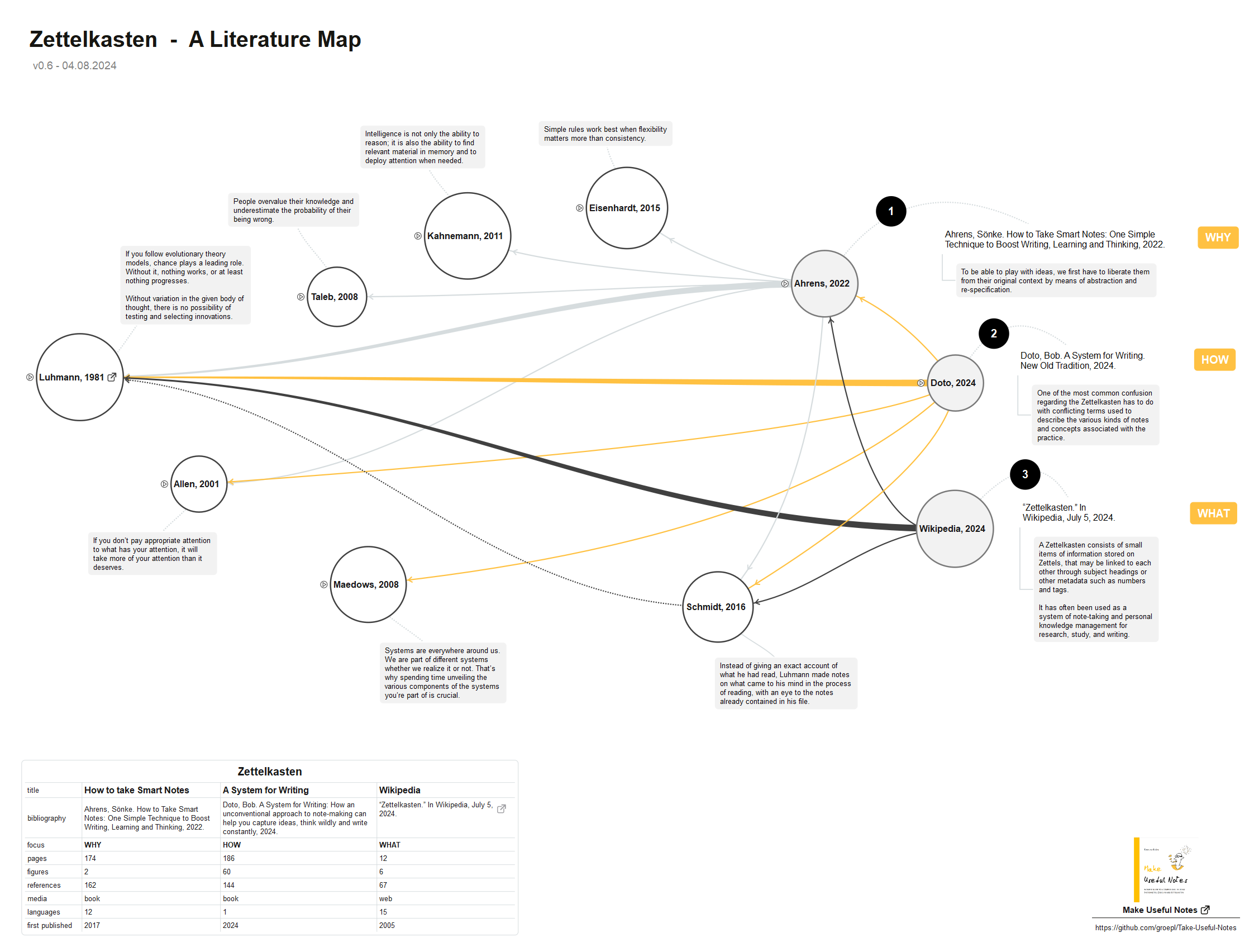
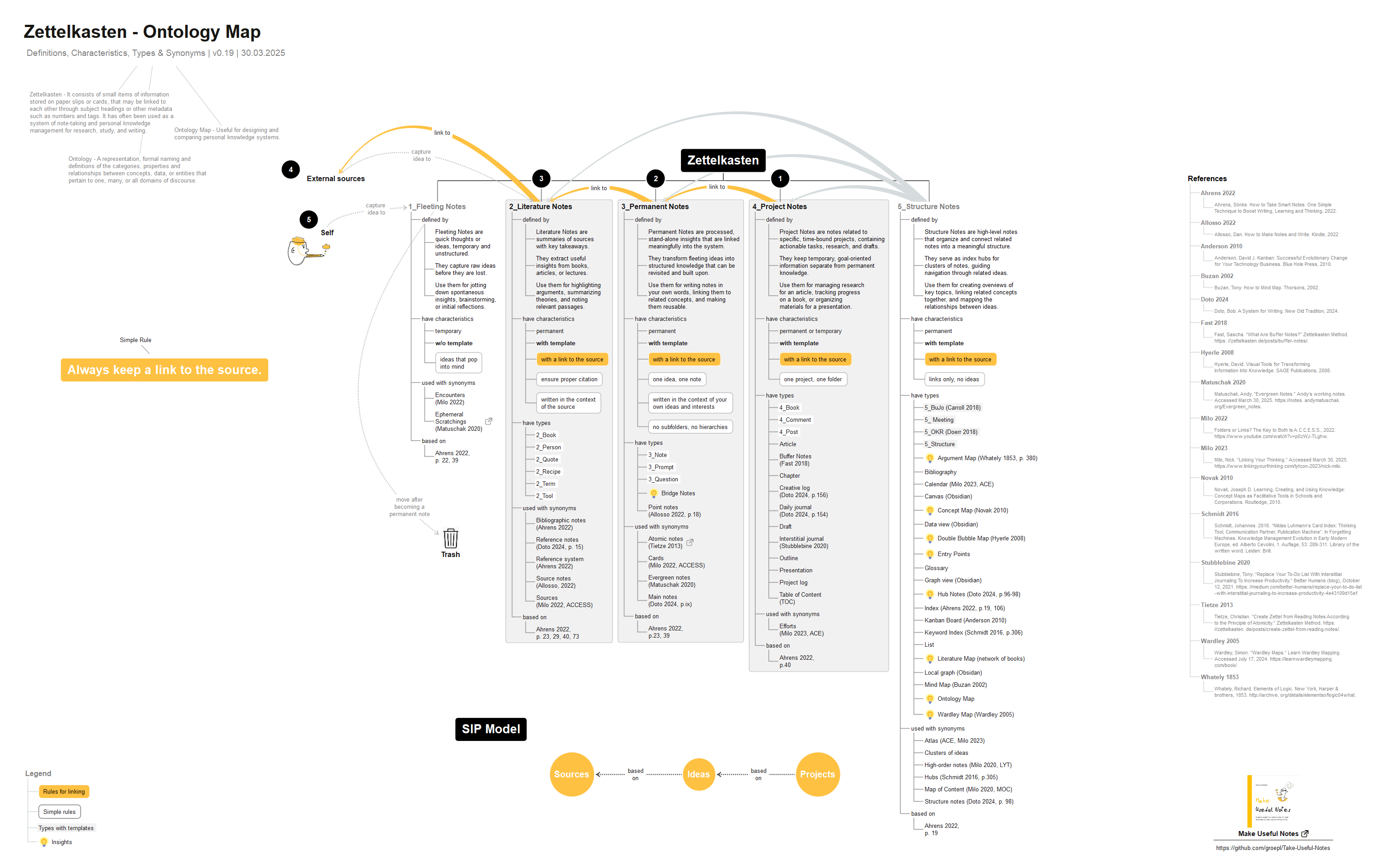
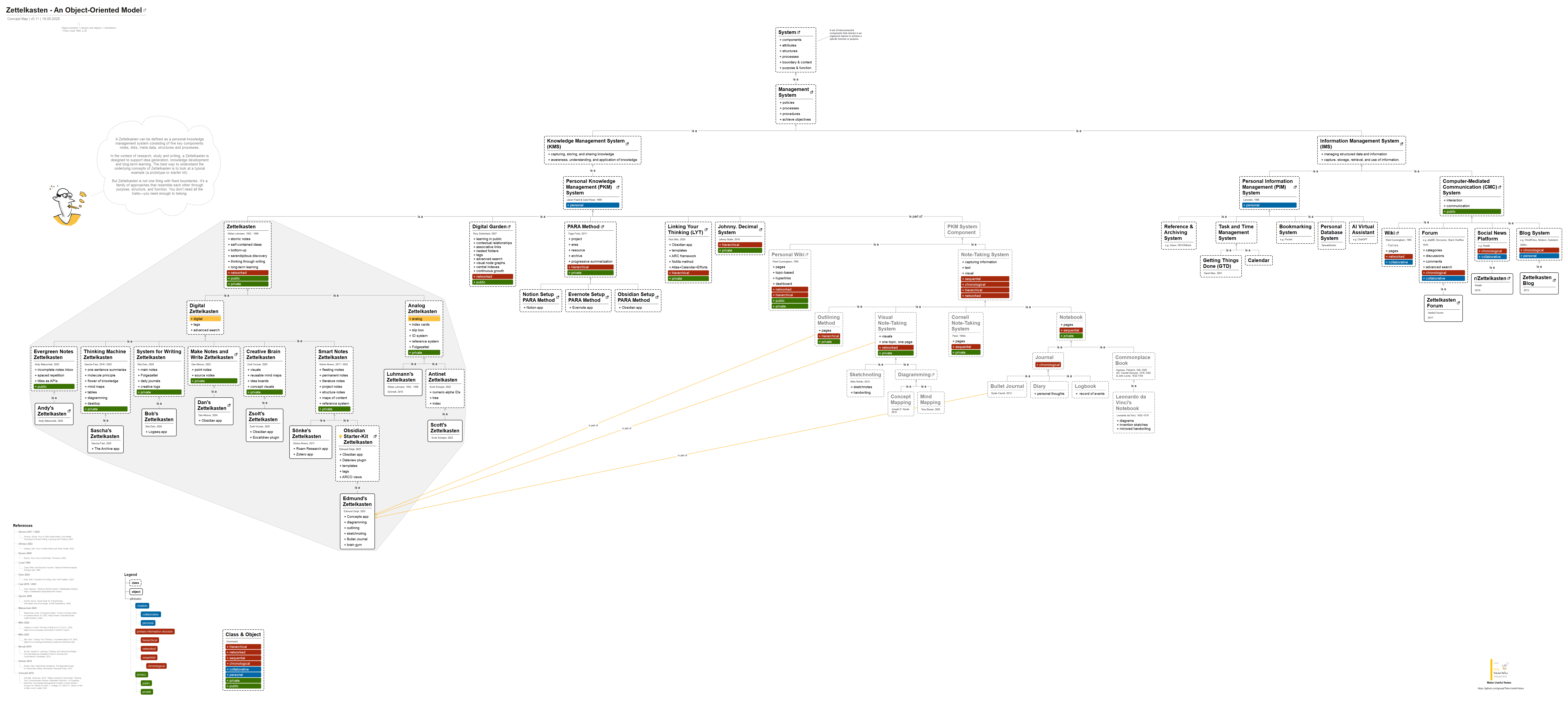
TBR
- Obsidian-Zettelkasten-Starter-Kit/README.md at main · groepl/Obsidian-Zettelkasten-Starter-Kit · GitHub
- link